
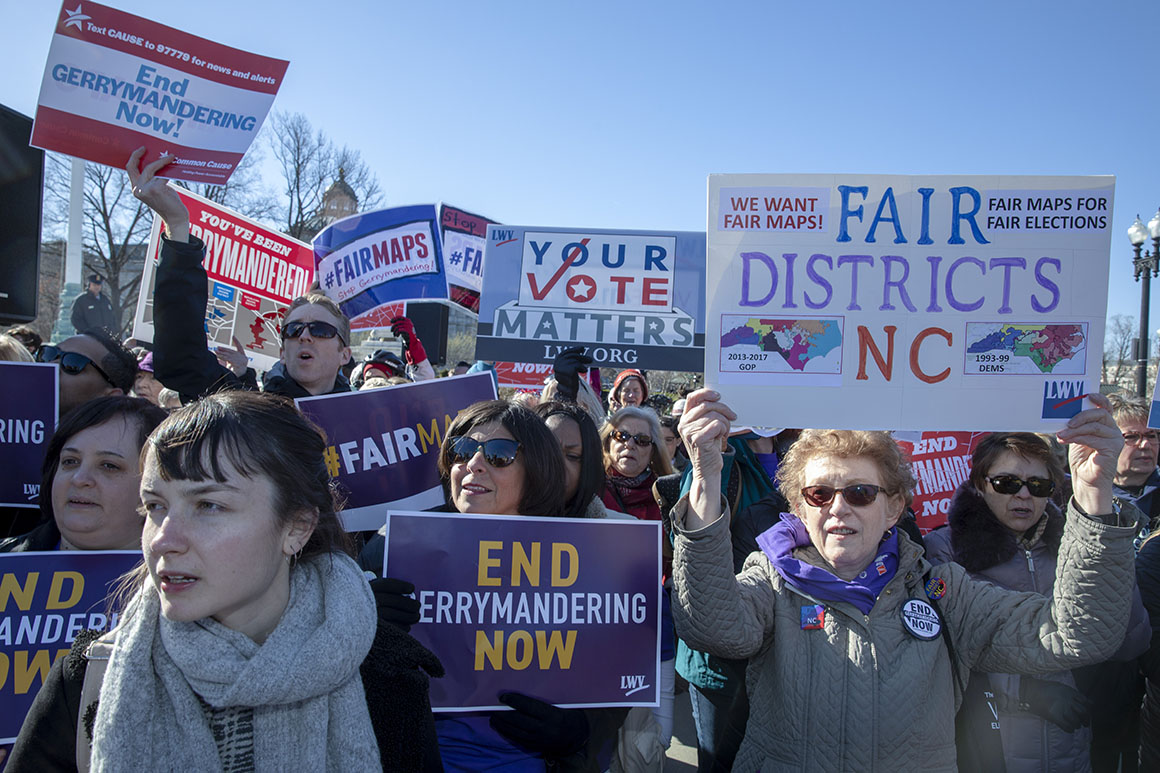
For years, Americans have been told that “gerrymandering” is one of the greatest threats to democracy. According to many on the Left, Republican-led states drawing favorable congressional districts amounted to an attack on fairness itself. But the Supreme Court’s recent redistricting decision has exposed something many conservatives have argued all along: Democrats are perfectly willing to play the same game when it benefits them.
The Court’s ruling in the Louisiana redistricting case has sent shockwaves through the political world, especially because it weakens the federal government’s ability to force states to draw districts based primarily on race. Predictably, liberal activists and media outlets immediately sounded the alarm, claiming the decision threatens voting rights and minority representation. But conservatives see something very different.

What the Court essentially recognized is that states should not be required to engineer districts according to racial quotas or political outcomes. That matters because, for decades, redistricting has increasingly become less about geography and communities, and more about guaranteeing certain political results.
Republicans have long argued that voters should choose their representatives — not the other way around. Yet Democrats routinely support aggressive redistricting efforts in states they control. New York is one of the clearest examples. After the 2020 Census, Democrats attempted to redraw congressional maps to maximize their advantage and squeeze out Republican representation. Critics noted that they even worked to weaken or sideline the independent redistricting process voters had approved years earlier.
And that’s really the heart of the issue.
The Constitution gives state legislatures broad authority over elections. Conservatives generally believe that local voters and elected state officials should have more say than unelected federal judges or bureaucrats in Washington. The Supreme Court’s recent ruling reinforces that principle by stepping back from micromanaging how districts must be drawn.
Of course, Democrats are furious because the ruling could strengthen Republican chances in several states ahead of the 2026 elections. RJBut it’s difficult to take the outrage seriously when Democrat-controlled states have pursued highly partisan maps of their own for years.
What’s especially interesting is how quickly the narrative changes depending on who benefits. When Republican legislatures redraw districts, it’s called “an assault on democracy.” When Democrats do it, it suddenly becomes “protecting representation.”
Americans are smart enough to notice the double standard.
There’s also a larger constitutional issue here. The Supreme Court has increasingly signaled that courts should not serve as permanent referees in every political dispute involving district maps. In previous rulings, including Rucho v. Common Cause, the Court made clear that partisan gerrymandering questions are often political matters best handled by voters and legislatures, not federal judges.
That doesn’t mean every map is fair or perfect. Redistricting has always been messy, and probably always will be. But the alternative — allowing federal courts to intervene endlessly whenever one party dislikes a map — creates even more instability and further politicizes the judiciary.
Ironically, some of the same voices now criticizing the Court had no problem with judicial activism when it advanced their preferred outcomes.
At the end of the day, this decision is really about restoring constitutional balance. States have authority. Legislatures have authority. And voters ultimately have authority at the ballot box.
Republicans should welcome this ruling because it pushes back against the idea that federal judges must settle every political disagreement. It also exposes the hypocrisy of those who condemn “gerrymandering” only when Republicans win.
The Left may not like the outcome, but the Supreme Court has reminded the country of an important truth: our system was never designed to guarantee political comfort for either party. It was designed to preserve self-government, federalism, and the rule of law.
And that’s a victory worth defending.